September 4 2023
Home cooked diet for dogs
(and for cats upon request)
(Three recipes currently on this page.)
When I have time on my hands and want to save money on ingredients (as compared with Fresh Pet Select), I home-cook for my dogs.
I buy all supplements at swansonvitamins.com
When I don't want to take the time and don't mind spending more on ingredients, I buy Fresh Pet Select from the refrigerated cabinet at Walmart. Other places charge much more for Fresh Pet Select.
I can't imagine that Fresh Pet Select is nutritionally inferior to my home-cooking. As with my cooking, it contains only premium ingredients, slow-cooked. Humans will enjoy eating both products.
On a ten percent moisture basis (for comparison with kibble):
My beef recipe below is 26/20 (protein/fat) and my chicken recipe further down is 30/18. Fiber in my recipes are 3.4 and 3.8
Fresh Pet Select is 31/19 in their beef version and 30/19 in their chicken version. Fiber is 4.7 percent in their beef version and 6.3 percent in their chicken version -- which is still within the standard range.
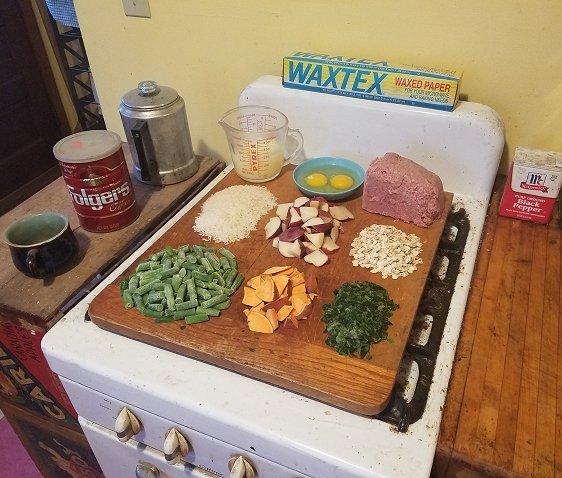
First, the sales pitch and some case histories. Below that you'll find a recipe for dog food along with the technical documentation.
--------------------
I assume there is more health potential in a raw diet than in a cooked diet, but I strongly prefer a cooked diet. Raw diets have too much potential for bacterial infections, and that is in fact something veterinarians see regularly in dogs and cats fed a raw diet.
Slow cooked (specifically boiled) food items are profoundly more healthy than foods subjected to extemely high heat or extrusion, such as is the case with all commercial kibble and canned foods.
Also, simply eliminating the undesirable ingredients (pink slime and other inferior renderings) found in kibble and canned pet food makes a profound health difference.
--------------------
Specific cases, chronologically:
1. Our nearly 21 year old cat (Sally) completely quit eating. Though she was always a trim cat with little fat to spare, her weight went from eight pounds to just four and a half pounds. University of Minnesota veterinarians did an exhaustive work-up and could find no issues. She was given a stomach feeding tube, and it seemed like a good time to try home cooking in conjunction with a blender to liquify the diet for her feeding tube.
It was a meatless diet, with cottage cheese as the primary protein source.
She accepted the food with rapture, and within two weeks was acting like a kitten -- taking flying leaps from the kitchen counter to the far away kitchen table and becoming playful again. This was vitality she had not exhibited in many years. Despite the trauma of having lost nearly half her body weight in the form of muscle and organ tissue (before regaining a couple pounds of it while on home cooking) she lived another one and a half years, passing away at 22 yrs 3 months and 8 days.
2. A much more profound case was that of my dog Jester. He was a Beauceron, a 100 pound French breed. At 10 1/2 years he completely quit eating. It seemed he was going to very soon die; he was nearly within the normal Beauceron life expectancy -- 11 to 13 years. Again, an exhaustive veterinary work-up could find no issue. I then offered him a home cooked meal. He ate for the first time in many days, and voraciously so. Within three weeks he was exhibiting vitality that I hadn't seen in him since he was a young dog. I of course kept him on home cooking the rest of his life and he lived to be 15 1/2 years old, apparently the world record holder for a Beauceron. Imagine if he'd had home cooking his entire life.
I eventually placed five more pets on home cooking, all of them very advanced in age when so placed. They all exhibited a profound increase in vitality within three weeks. They all lived a couple or a few more years despite being seemingly near their end when initially placed on home cooking.
Those cases were all from the years 2001 to 2011. I now have two middle aged dogs and have recently placed them on home cooking.
------------
THE RECIPE
09/04/23 update
A 30/18 chicken recipe is now included
at the bottom of this page. It is nutrionally
slightly superior to the beef recipe immediately
below, and my dogs are especially wild about it.
The following recipe is nearly the best I have to offer. It uses beef that is 80/20 (protein/fat). I'm currently using that form of beef because a local market is selling it at less than half the normal price and I've stocked up. I'm using egg white to bring the protein/fat ratio up to a more acceptable level, despite having to make some minor nutritional compromises (sodium and fat are a little on the high side). If any reader of this website would like a recipe that uses 85/15 beef, just let me know and I'll do the work and post it.
Also, if any reader would like a cat menu, let me know. Same goes for any reader who would like a KD diet for dogs or cats. I developed scores of such recipes years ago, but only care to post the very best recipes I have to offer.
The recipe below has the following protein, fat and fiber profile, calculated on a 10 percent moisture basis for ease of comparing with kibble (which is what you're probably most familiar with):
protein 26.1
fat 20.4
fiber 3.4
It's good to keep the fiber between 3.5 and 6 percent. It's good to have protein 26 percent or higher and fat 16 percent or higher. My best (and most expensive) recipes have a protein/fat profile of 32/18.
All measures are of the ingredients in raw form. This 2800 kcal menu is for my two dogs for one day.
A good inexpensive gram scale can be purchased at Walmart.
Ingredients, by caloric content:
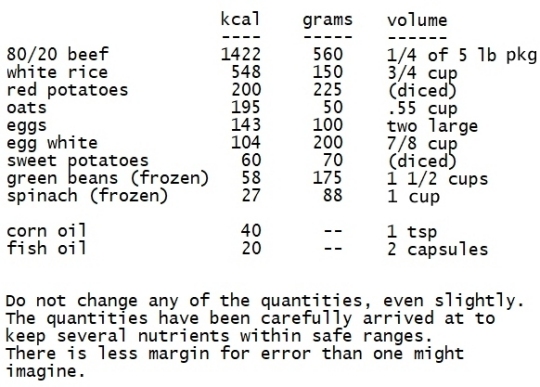
It's vital to include the peelings of the potatoes and sweet potatoes for adequate fiber.
Simmer the beef and rice in water for 15 minutes.
Add the red potatoes, sweet potatoes, green beans and oats. Simmer for another 15 minutes.
Add the eggs and egg white (purchased in cartons) and simmer for another four minutes. (It's important to cook the egg white since even pasteurized raw egg white will interfere with the absorption of biotin.)
Add the spinach, oils and supplements.
Supplements for this 2800 kcal menu:

I'm now also adding about a half ounce of chicken or beef liver, a half teaspoon of spirulina (dense green powder), and a couple teaspoons of raw ground flaxseed meal. No need to adjust supplementation.
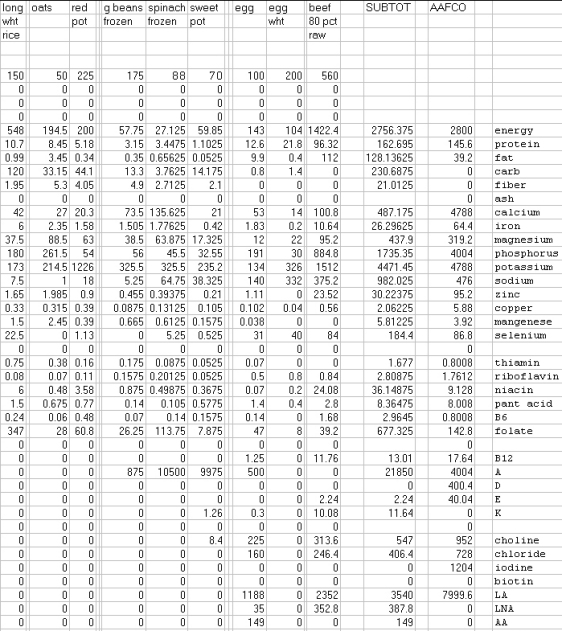
You'll notice that I haven't exhaustively entered data for choline and several other nutrients. This is for various reasons having to do with what's relevant and with what there are AAFCO standards for.
I have a quirk (which I won't go into) regarding potassium, and sometimes settle for a level in the diet at 5 to 10 percent lower than the AAFCO recommendation. To bring it up to standard, increase the red potatoes quantity to 275 grams while lowering the white rice quantity to 135 grams. In fact, that would be a good idea in this case, as the sodium is on the high side and potassium-sodium balance is a consideration.
-------
Again, feel free to request an 85/15 beef version of this menu, cat menus, or KD menus.
April 25 2021
Roger Luebeck
roger@rogcad.com
--- RECIPE NUMBER TWO: CHICKEN ---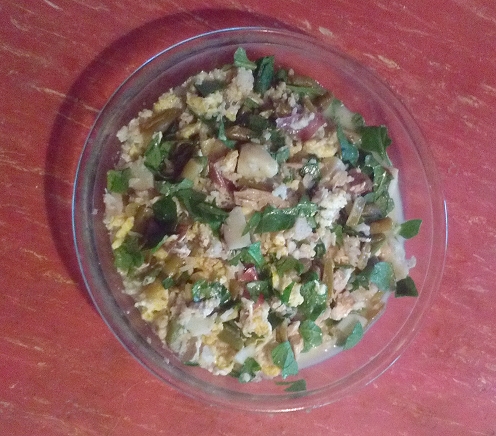
This chicken recipe (same as spreadsheet image immediately above) is 1500 kcal daily for my 90 pound dog. A good inexpensive gram scale can be purchased at Walmart. Daily amounts for 1500 kcal: kcal grams volume ---- ----- ------ chk thigh w/skin 338 160 -- chk breast skinless 242 220 -- white rice 219 60 0.3 cup red potatoes 147 210 diced eggs 143 100 two large oats 115 30 1/3 cup green beans frozen 66 200 1.7 cup canola oil 63 7 1 T corn oil 41 5 1/2 T fish oil 36 4 2 capsules spinach frozen 8 25 1/3 cup All ingredients are as measured in raw form. Measure accurately. Do not include bones in the weight measure. Slow roast the chicken at 300 degrees. Boil: rice 35 minutes potatoes 35 minutes green beans 20 minutes oats 7 minutes eggs 5 minutes It's vital to include the peelings of the potatoes for adequate fiber. For 1500 kcal daily intake (90 lb dog): morning evening ------- ------- energy (kcal) 750 750 supplements: dicalcium phosphate 3/4 tsp 3/4 tsp calcium carbonate 1/2 tsp 1/2 tsp iron 32 mg (1/2 tablet) zinc 50 mg (1 tablet) copper 2 mg (1 tablet) iodine 225 mg 450 mg (from kelp tablet) choline 250 mg 250 mg D 2 drops E 1 capsule every four days K occasional B 12 sliver (minimum 10 mcg) Daily small beef or chicken liver treats won't affect the supplementation. ----------------------------------------------------- Again, feel free to request an 85/15 beef version of the first menu, as well as cat menus or KD menus. September 4 2023 ===================================================== September 22, 2025 addition: See olden-days.me for background information regarding my switch to vegetarian menus for dogs and cats. Also note that my very first menu -- back in 2001 -- was a meatless menu for our 21-year-old cat. See the story higher up on this page. Meatless premium dog food:

For best flavor, serve the yogurt separately. Combine all other ingredients, including supplements, in a separate bowl. The flavor of both bowls is excellent, whereas if all is combined in one bowl, the taste is quite bad. My Bucky likes one bowl as well as the other -- sometimes eating one bowl first, sometimes the other.
roger@rogcad.com